
Morch


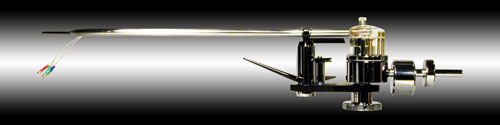
Hans Henrik Morch is undoubtedly one of the greatest advocates of analog audio systems. As early as the 1970s, he made a name for himself as someone who deeply understood the challenges faced by the designers of turntables at that time. After several years of gathering experience and making observations, the tonearms that were the culmination of his research saw the light of day. The Morch tonearm consists of a base containing a bearing assembly and a counterweight, as well as a lift mechanism and the tonearm tube. A distinctive feature of Morch’s design is the removable tonearm tube, which is attached to the base with just a single screw. Four types of tubes are available, each with a different weight (from 4 to 14 g), allowing for optimal matching to your insert. The shape of the tube and its damping material counteract mechanical resonances that affect the operation of the cartridge’s moving parts. Owners of multiple cartridges can purchase additional tubes, eliminating the need to readjust the system each time—excluding, of course, adjustments for tracking force and height. The chamber containing the bearings is offset to the side relative to the longitudinal axis, ensuring an asymmetrical load distribution. This solution counteracts the symmetrical resonance in the suspension system. The tonearm body, together with the rigidly mounted tube and the counterweight system, constitutes a fairly substantial mass, thereby ensuring effective damping of vibrations originating from the cartridge before they reach the bearing assembly. The counterweight consists of three weights of varying masses that determine the proper load distribution, and one weight responsible for the tracking force. The eccentric weight mounting system allows the tonearm to be adjusted in the transverse plane (azimuth) as well. The aforementioned bearings are mounted quite high; they are practically located on an extension of the plane defined by the surface of the platter, thereby minimizing the impact of “warped” platters on the performance of the cartridge-tonearm system. . Centrifugal force compensation (anti-skating) is achieved using a coil spring, the tension of which is continuously adjustable via a lever. The force is transmitted through a nylon string to the body, where the precise attachment point ensures that the correct geometry of the anti-skating system is maintained.
The patented tonearm design has earned widespread acclaim among customers, who appreciate the system’s excellent tonal balance. The use of an interchangeable tonearm tube has significantly improved ease of use and configuration options.
Two types of tonearms are available, differing in their bearing systems. The DP-6 version is equipped with independent bearings for vertical and horizontal movement. The UP-4 model is equipped with a single bearing that allows movement in both planes—this is known as a unipivot system. Each tonearm features adjustable tracking force, an anti-skating system, and adjustments for height and azimuth. The DP-6 series tonearms are available in both 9“ and 12” versions.
The tonearms are manufactured in two finish options: chrome-plated and gold-plated. The internal wiring and signal cable can be made of silver wire.