
DV 507 MkII
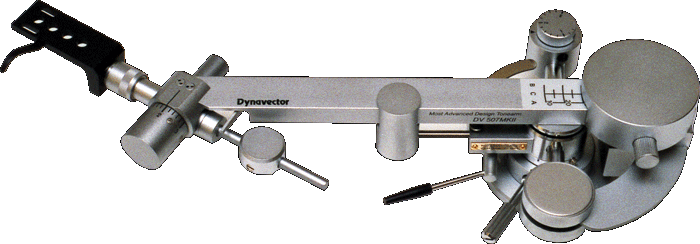
DV – 507 MkII
To produce a tonearm compatible with as many turntables as possible, Dynavector designed the
DV 507 MkII, the successor to the DV 501 and DV 505 tonearms, which were highly regarded and won awards at the CES in 1977, 1982, and 1985.
Compared to those models, the “507” features numerous changes that have significantly improved its sound quality as well as its ease of use
and installation.
The Dynavector tonearm is unlike standard tonearms. As Dynavector itself describes it, it is a “Bi-axis” system—that is, a tonearm with two “tubes,” or rather axes, that operate independently in the vertical and horizontal planes. This has made it possible to separate and differentiate the inertia in the vertical and horizontal planes, which is essential for accurate sound reproduction from a record. The DV 507 MkII has high inertia in the horizontal plane and low inertia in the vertical plane.
Explanation – A phono cartridge generates a signal through the movement between the tonearm and the cartridge housing. Consequently, if the cartridge’s point of support—that is, the tonearm—begins to vibrate, these vibrations are superimposed on the audio signal. The tonearm’s vibrations have a low frequency and high amplitude.
In the technology currently used for pressing 33- and 45-RPM records, low-frequency signals are almost entirely recorded in the horizontal plane, which means that a signal capable of causing vibrations in the tonearm manifests as a horizontal force. Therefore, the tonearm must have sufficient effective mass and stiffness in this plane to provide a stable platform for the cartridge.
On the other hand, for mid and high frequencies, the effective mass of the system (tonearm, cartridge) should not be too high in order to ensure the best possible “groove tracking,” especially on slightly worn records. In summary, the tonearm should have high effective mass and high damping in the horizontal plane, and low effective mass and low damping in the vertical plane. These requirements cannot be met by a standard tonearm. To achieve this, Dynavector has just introduced the “Bi-axsi” system.
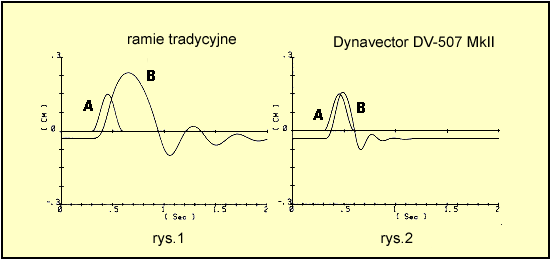
Figs. 1 and 2 illustrate the difference in the behavior of a standard tonearm and the Dynavector DV-507MkII. Line A represents the signal on the record,
while line B represents the movement of the tonearm and cartridge assembly. As can be seen, in the case of the DV-507, this movement is much closer to the recorded signal.
The tonearm features a contactless eddy current damping system using neodymium magnets.
Dynamic tracking force adjustment.
Dynamic sub-arm damping.
Anti-skating adjustment.
VTA adjustment.
More information http://dynavector.com/products/tonearm/e_507mk2.html
| Technical Specifications | |
| Overall length | 306 mm |
| Effective length | 241 mm |
| Overhang | 15 mm |
| (Offset) | 21,5 degrees |
| Height adjustment | 33 mm |
| Recommended weight of the insert | 15-35 g. (with headshell) |
| Arm mass | 1 380 gr. |