
SERIES V
SERIES V
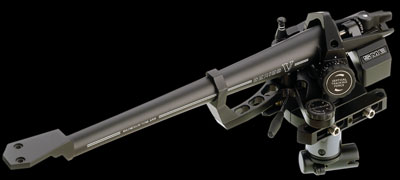
The V SERIES represents virtually the pinnacle of modern technology in the field of tonearm manufacturing.
SME’s vast experience and excellent technical resources have resulted in a design that combines watchmaker-level precision with superb sound quality.
Below is an excerpt from an article by Mr. Dariusz Słoboda published in issue 1/96 of “Magazyn HiFi,” which describes the design of the “Series V.”
“…Since its first unveiling in 1984 (still as a prototype), the Series V has managed to establish itself as one of the best tonearms in the world. And for good reason. Like the Model 30, it is a truly remarkable piece of engineering. At first glance, it looks very delicate, but that impression is deceptive.
Alastair Aikaman offers a free new SME Series V tonearm to anyone who visits the factory, provided they break it first. Unfortunately, no one has managed to do so yet (including me—GS). The reason for this is the material from which they are made—namely, a magnesium alloy. It is about 36% lighter than aluminum, which is typically used to cast tonearms, but only 25% less rigid. As a result, a magnesium construction can be approximately 25% stiffer than a comparable aluminum one. This, of course, results in less flex and vibration in the tonearm. Reducing the number of joints along the path from the cartridge to the subchassis also plays a significant role in this. The tonearm tube, approximately 293 mm long and including the cartridge mount, is extruded as a single piece. The interior is lined with damping material. At the end, it is attached to the tonearm plate via a spindle equipped with a full set of adjusters.
I’ll start the description from the top. The highest part of the SME Series V is a steel half-ring that closes off the tube at the top. It is secured with two screws to a steel yoke that wraps around the tube. Inside the yoke is a roller equipped with 10-millimeter ball bearings. This roller is positioned at the level of the plate, which is designed to prevent it from warping and, consequently, to prevent sound distortion. It allows the tonearm to be raised and lowered. A spring connected to it is used to adjust the needle’s tracking force on the record. This is done using a side-mounted knob. The tracking force can be adjusted smoothly within a range of 0–3 grams. A vertical shaft is also attached to the bottom of the yoke via a 16-millimeter-diameter flange. It moves inside a steel spindle equipped with two 17-millimeter-diameter ball bearings. The 23-mm-diameter spindle itself is the component that secures the tonearm to the turntable, along with a special base, which will be discussed later. The two bearings are spaced as far apart as possible to minimize the tilt of the vertical shaft. An anti-skating mechanism, a tone arm lift/lower system, and a reservoir for damping fluid are also attached to the spindle. Anti-skating control is achieved using a spring and a thread. The regulator dial corresponds to the one that controls the tracking force and is set to a forced “off” position. The height of the arm can be adjusted using a screwdriver. The Series V can operate with or without damping fluid.
The counterweight is made of a tungsten alloy. The counterweight is damped and suspended at two points using screws. The unique shape of the entire counterweight allows it to be positioned close to the suspension point. This reduces inertia and thus prevents distortion caused by damage to the platter and its lack of concentricity.
The counterweight slides along rails with sides inclined at a 45-degree angle. This is made possible by a knurled wheel and a lead screw, mounted on a double-row ball bearing.
The rail itself is 19 mm long and is sufficient for balancing cartridges weighing between 4.2 and 18 g. The tonearm is mounted to the turntable using a special base.
It allows for vertical movement between the two jaws and horizontal movement along the guides. The horizontal position is set using four transverse screws located in the guides. The assembly is then secured to the arm plate with four cap screws. The base also contains a screw for adjusting the horizontal reading angle (HTA). Adjustment of the vertical tracking angle (VTA)—and thus the height of the tonearm above the record—is accomplished using a screw located next to the damping fluid reservoir.
The internal wiring consists of silver Litz wire. It terminates in a DIN connector at the base of the tonearm. From there, an oxygen-free copper cable equipped with gold-plated RCA connectors continues. Its length is 1.2 meters.
The arm is finished in black, with elements made of polished steel and coated with black or silver chrome. It weighs 720 grams. Its height can be adjusted from 56.4 to 87.9 mm above the mounting surface. The depth below the mounting surface is 56.75 mm. It is delivered to the customer along with accessories for installation and adjustment…”
Key Features of the “5”
Unique design of the arm tube, extruded entirely from magnesium alloy.
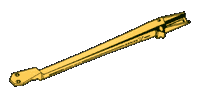
The inner surface of the tube is coated with a special compound that dampens any residual vibrations that may arise within the arm’s structure.

The head platform’s surface is meticulously machined to prevent resonance at the point of contact with the cartridge.

A stainless steel spindle with 10-mm ABEC-7 ball bearings mounted on it. The entire assembly is supported by a solid yoke and positioned at the same height as the platter surface, which effectively prevents sound distortion.

Dynamic needle pressure adjustment, controllable within a range of 0–3 grams with an accuracy of 0.125 g

A unique method for assembling individual components that ensures high rigidity and guarantees a precise fit of the bearings even before the entire arm is assembled.

The vertical bearing shaft is made of stainless steel and features an integrated 16-mm-diameter flange that connects it to the yoke.
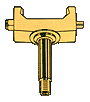
Made of hardened steel, this 23-millimeter-diameter vertical bearing housing is equipped with a pair of 17-millimeter ABEC 7 ball bearings. The bearings are widely spaced to prevent the arm from tilting.

Anti-skating force adjustment is achieved using a fiber connected to a spring. The dial is calibrated according to the values on the tracking force (VTF) knob.

A lift that allows for precise lowering and raising of the needle from the surface of the plate. Its range of operation can be adjusted.

A system for oil-based damping of transverse arm vibrations occurring in the infrasonic range.
It can be turned on or off depending on the user’s preference.

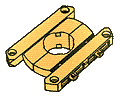
A two-piece base that provides high rigidity and enables precise control of arm movement.
A counterweight made of a tungsten alloy, supported at two points and damped. Its special low-inertia design reduces the impact of eccentrically machined plates on the insert’s operation.

The suspended counterweight housing ensures optimal distribution of the center of gravity. This mounting configuration further stiffens the end of the arm tube, preventing uncontrolled vibrations in the system. The counterweight can be adjusted by rotating the knurled ring after first unlocking the locking nut.
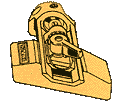
The swivel output connector allows for optimal routing of the signal cable. This design also minimizes the transmission of vibrations to the subchassis.

The ability to adjust the tonearm height (VTA) using a screw located in the tonearm body.

Precisely marked horizontal lines on the arm tube make it easier to adjust the arm to the correct height.

Precise adjustment of the horizontal reading angle (HTA) using a screw mounted in the base.

A special template makes it easy to set the optimal horizontal reading angle.

The tool included in the set makes it easy to install the tonearm on any turntable.

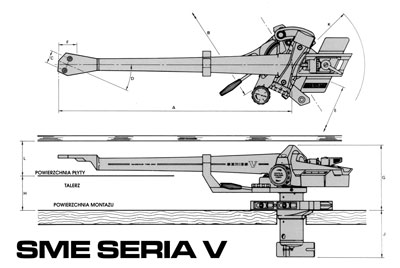
Technical Specifications for the V SERIES Arm:
| A | the distance between the arm’s axis and the insert | 233,15 | mm |
| B | the distance between the axis of the arm and the axis of the plate | 215,35 | mm |
| C | spacing of the screws securing the insert | 12,7 | mm |
| D | offset of the insert axis | 23,635 | o |
| E | linear shift | 93,47 | o |
| F | insert projection | 17,8 | mm |
| G | height above the mounting surface | 56,4 – 87,9 | mm |
| H | the range of the panel’s height relative to the mounting surface within which the arm can be installed | 26,4 – 57,9 | mm |
| J | depth below the mounting surface | 56,75 | mm |
| K | radial play (range of motion) of the counterweight | 73 | o |
| L | clearance between the cover and the surface of the plate with a 17-mm-high insert | 35 | mm |
| Effective mass | 10/11 g | |
| Insert Balancing Range | 4,2 – 16 g | |
| Pressure Adjustment | 0 – 3g (30mN) | |
| Maximum tracking error | 0,012 o/mm | |
| Zero points (Baerwald) | 66,04 i 120,9 mm | |
| Signal cable | ||
| length | 1,2 m | |
| capacity | 140 pF/m | |
| resistance | 0,145ohm | |
| Internal Wiring | ||
| capacity | 15 pF/kanał | |
| resistance | 0,535ohm | |
| Output plug | 5 – contact D.I.N 240 o | |
| Weight | 720 g | |
The arm is also available in a version with a removable head. You can also purchase an arm with gold-colored accents or a fully gold-plated arm.