
Air Force Two
Air Force Two
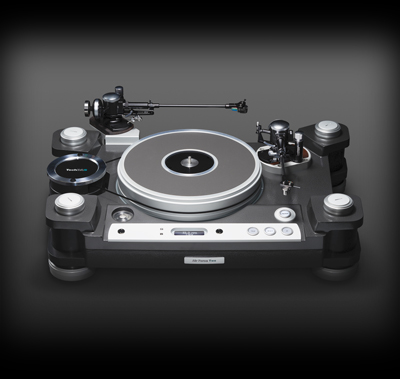
When the Air Force One turntable was launched, the analog audio world hailed it as a reference model—a technologically advanced device that brings out the very best in vinyl records. Its “younger brother,” the Air Force Two, is the Japanese manufacturer’s response to the need for a simpler and more affordable device crafted with similar passion and ingenuity.
Inherited from the Air Force One, the design incorporates a vacuum platter system and an air cushion in the platter bearing to ensure complete stability during vinyl rotation. Vinyl is a highly sensitive medium, where even the slightest vibration or friction can cause unwanted playback issues. A turntable should provide a consistently stable platform for the record. Any unwanted signal—even the slightest one—picked up by the cartridge’s stylus distorts the music being played. Examples of sources of such interference can be found in many key components of an audio system—problems arise both within the devices themselves and in the rooms where they are located. Even what might seem inherent to the mechanical operation of a turntable—such as the friction generated when the platter rotates—can distort the music coming from the speakers. Many companies have attempted to find solutions to these problems, with varying results.
To overcome these challenges, the Japanese turned to air—and that’s how the concept of an air-bearing turntable with a system that suctions the record to the platter was born. The turntable’s primary function is to ensure stable, precise, and interference-free rotation of the platter. Inertia is essential for ensuring stability. This means that the turntable platter must be sufficiently heavy. The Air Force Two therefore features a 10-kg platter. The flip side of the coin, however, is bearing wear, which is exacerbated by excessive platter weight. Such wear on the mechanism causes friction and reduces its precision. The solution to this problem is the air bearing, familiar from the flagship Air Force One model. This solution involves doing away with conventional bearings. The platter is mounted solely on a glass plate with a polished, flat surface. At this point, the platter is completely stationary. This changes as soon as an external pump begins supplying air to the turntable. The platter begins to float on an air cushion just 0.03 mm thick, rotating smoothly. Since the weight of the platter does not rest on any mechanism at this time, not only are friction and vibrations eliminated, but the design’s longevity is also ensured. However, this is not the end of the ambitious use of air to improve the performance of the Air Force Two. Despite ensuring unmatched stability and precision in the platter’s operation, even the slightest surface irregularities on a vinyl record can cause unwanted vertical movements of the tonearm, and these unwanted movements of the stylus will induce resonance. Under such conditions, faithful signal reproduction is out of the question. Various types of discs have partially addressed this problem, but for the designers at TechDAS, that’s not enough. This is where the record-to-turntable suction system comes into play—with a single press of the SUCTION button, a pump activates, firmly suctioning the record to the rotating platter. This smooths out the record’s surface, effectively eliminating unwanted vertical movements of the tonearm and allowing the cartridge to perform at its best, reading only what should be read from the record. Air is also utilized in the Air Force Two’s suspension system. This isolates the turntable from vibrations originating from the floor and other sources. Other turntable suspension solutions fail to effectively counteract vibrations caused by loud music playing through speakers or movement within the room. The feet used in the Air Force Two significantly reduce the transmission of vibrations from the surroundings to the turntable thanks to their damping properties. All these solutions leave us with just one question: what did TechDAS do to lower the price of this device without sacrificing quality? The Japanese company found cost savings in the design of the enclosure. The expensive, precision-cut CNC-machined and assembled structure has been replaced with high-quality cast aluminum parts, which are then painted. This solution has reduced costs and significantly increased the material density, resulting in the Air Force Two’s enclosure weighing as much as 32.6 kg, despite its simpler design compared to the Air Force One. The Air Force Two allows for the installation of two tonearms. Tonearms up to 10 inches in length can be mounted on the right side of the cabinet. An optional tonearm base mounted on the left side allows for the use of tonearms measuring 9, 10, and 12 inches in length. Both types of tonearms can be mounted simultaneously without any issues, significantly expanding the capabilities of the Air Force Two system. The turntable platter is precision-machined from a solid block of A5056 aluminum and features a mechanism that secures the record to its surface. In addition, the top of the platter is covered with specially selected damping materials. A belt made of non-stretch, polished polyurethane is used to drive the platter. It ensures greater precision in the platter’s movement compared to its rubber, stretchy counterparts. The turntable’s motor is housed in a separate enclosure made using the same technology as the chassis, located on the left side. A sensor monitors the turntable’s rotational stability, allowing the built-in microprocessor to correct the speed by the smallest increments in real time. Speeds of 33 1/3 and 45 revolutions per minute are available. Additionally, the pitch of the playback can be adjusted by up to 10% in 0.1% increments. The turntable’s power supply, compressor, and air pump are housed in a separate enclosure. The high-quality pump and thick walls ensure that any operational noise is suppressed. The same enclosure also houses a condenser through which the air exiting the pump passes before reaching the turntable. Taken together, all these features make it clear—the Air Force Two is the perfect realization of the vision for a more affordable counterpart to their groundbreaking model. The solutions implemented in these turntables make them unique, and despite its lower price, TechDAS’s “Two” is worthy of standing alongside the Air Force One on the pedestal of analog record playback technology.
Specifications:
| Drive System | Belt Drive, Surface polished polyurethane fiber flat belt |
| Platter | Solid aluminum (A5056) , weight 10 kg |
| Motor | AC synchronous moter. Speed controlled by DC amplifier |
| Chassis | Precision aluminum castings, weight 32.6 kg |
| Rotation Speed | 33 1/3 rpm, 45 rpm Precise speed adjustment function. |
| Wow & Flutter | below 0.03% (W.R.M.S) |
| Minimum Dimensions for setting up | 685(W)×460(D)mm |
| Total Weight | 47 kg |
| Power Supply Unit | Power consumption: 60W Dimension and weight : 430(W) x 150(H) x 240(D) mm, 10kg Operation voltage: 100 / 120 / 220 / 240 V (50 / 60 Hz) |